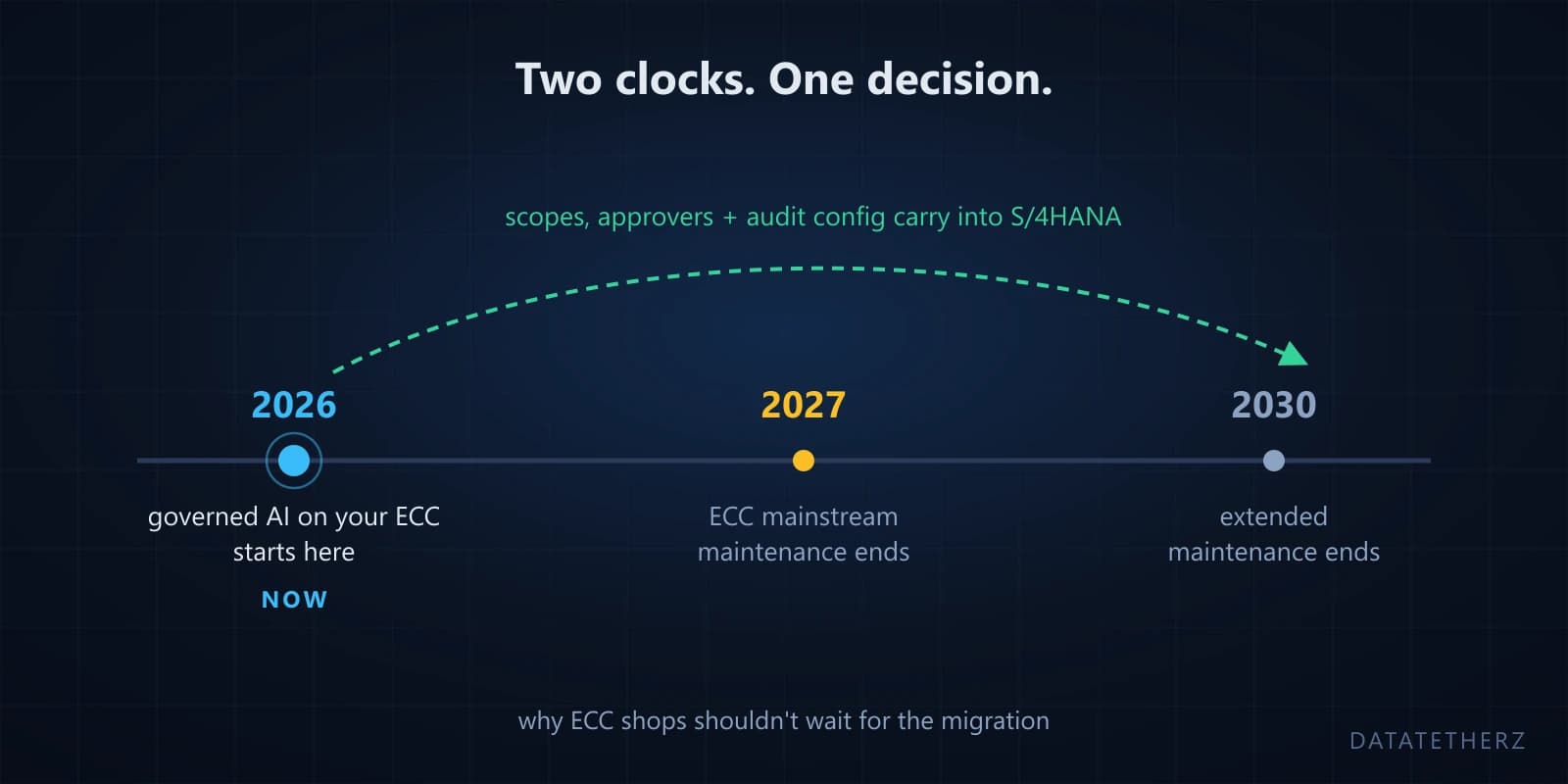
If you run SAP ECC, two clocks are ticking on you at once.
The first is SAP's: mainstream maintenance for ECC ends in 2027, with paid extended maintenance running to 2030.¹ Whatever your S/4HANA migration plan is, the pressure on it is real and growing.
The second clock is newer and, in most companies, louder: the AI mandate. Leadership has rolled out Claude, ChatGPT, or Copilot, seen what it does for documents and code, and is now asking the obvious next question — why can't it work with the system that actually runs the business?
The standard answer to holding both clocks is sequencing: migrate first, then do AI properly on S/4HANA. It sounds disciplined. It's also the answer we'd push back on hardest.
What "AI after the migration" actually costs
Do the arithmetic on your own timeline. A typical S/4HANA migration runs multi-year from decision to stabilization — and that's before the AI work it was supposed to unblock even starts. Sequencing means your ERP, the highest-value data and process surface in the company, contributes nothing to the AI programme for the duration.
Meanwhile the rest of the organization doesn't wait. AI habits form around whatever's connected — documents, tickets, spreadsheets — and the ERP becomes the conspicuous hole in every answer. Three years of "the assistant can't see SAP" is three years of shadow exports, retyped reports, and an AI programme that plateaus at the edge of where the business actually lives.
And the people best placed to fix it — your SAP team — spend those years fully consumed by the migration, watching the AI mandate get answered by everyone except them.
The false premise in the sequencing
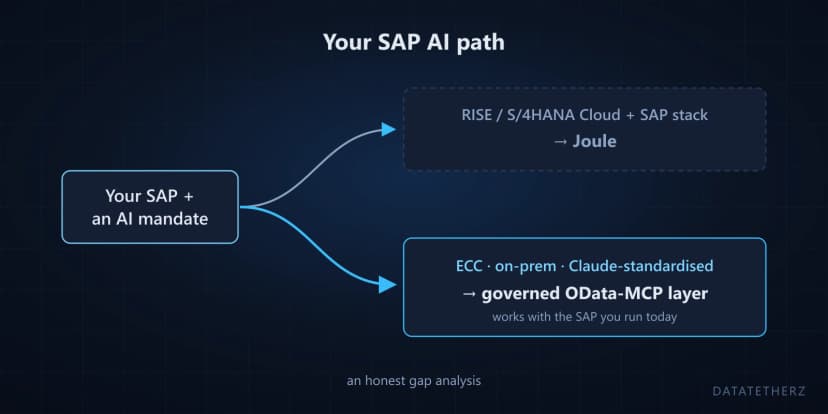
The migrate-first logic rests on an assumption that used to be true: that AI capability requires a modern SAP stack — S/4HANA, BTP, Joule. For SAP's own copilot, that's still the deal.
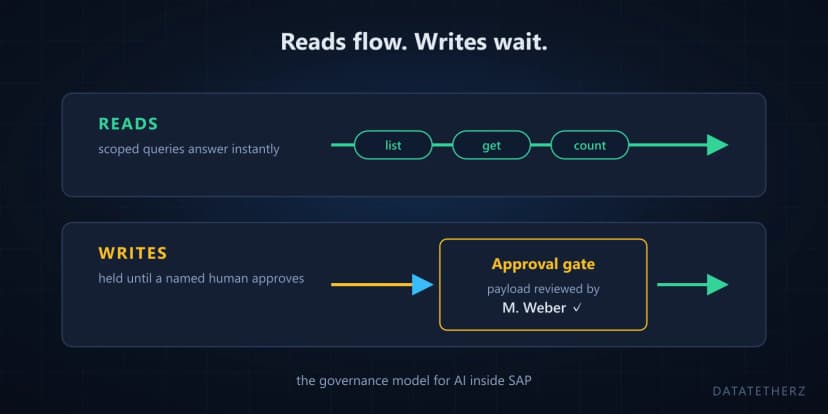
But the interface AI actually needs from your ERP isn't the new stack. It's OData — and ECC behind SAP Gateway has exposed OData services for over a decade. The same services your Fiori apps use describe themselves completely: entities, fields, keys, functions. That self-description is enough to generate governed AI tools from — scoped reads, approval-gated writes, a full audit trail — with no ABAP changes, no transports, and nothing added inside the landscape a migration team would have to work around.
In other words: the ERP you're migrating away from is already AI-ready at the interface level. Waiting wasn't buying safety. It was just waiting.
The part that survives the migration
The strongest objection to doing AI on ECC now is throwaway work: "we'll just rebuild it all on S/4HANA." It's the right worry aimed at the wrong layer.
What you build in a governed AI layer isn't ABAP and it isn't tied to ECC's internals. It's decisions: which entities are exposed, which fields stay dark, which writes exist and who approves them, what the audit trail must capture. That governance configuration — and the organizational muscle of reads flowing while writes wait — carries forward. When the migration lands, you point the layer at S/4HANA's OData services and bring your scopes, approvers, and habits with you. The AI client doesn't change. The assistant your team spent two years learning to work with doesn't change.
Sequenced the other way, you arrive on S/4HANA in 2028 with a modern ERP and an AI programme still at day zero.
Running both clocks
The reframe for your steering committee: these aren't sequential projects competing for the same team. The migration is a multi-year infrastructure programme. Governed AI access is an afternoon per OData service, run from outside the landscape, that starts paying back immediately and hands the migration a finished governance model instead of a to-do.
If the pilot risk is what holds this conversation back, start where there's no risk at all: the fifteen-minute walkthrough on a public demo service. And when you're ready to run the discussion against your own ECC services, request guided access — bring the person who owns the migration plan.
¹ SAP's announced timeline for SAP Business Suite 7 / ECC 6.0: end of mainstream maintenance in 2027, optional extended maintenance to 2030. Check your contract for your landscape's specifics.
 sap
sap