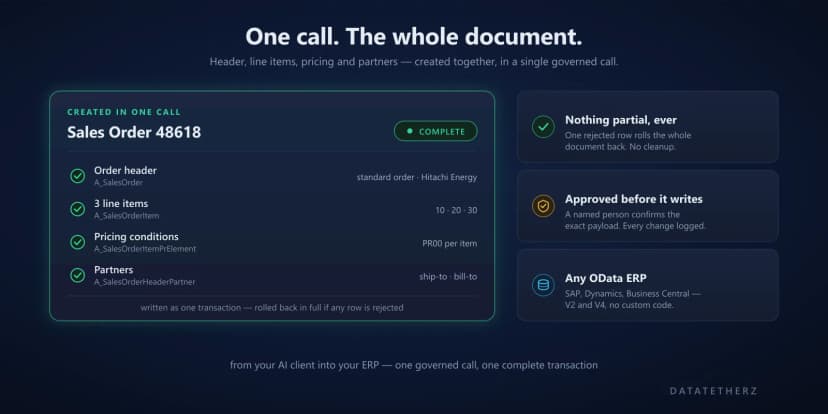
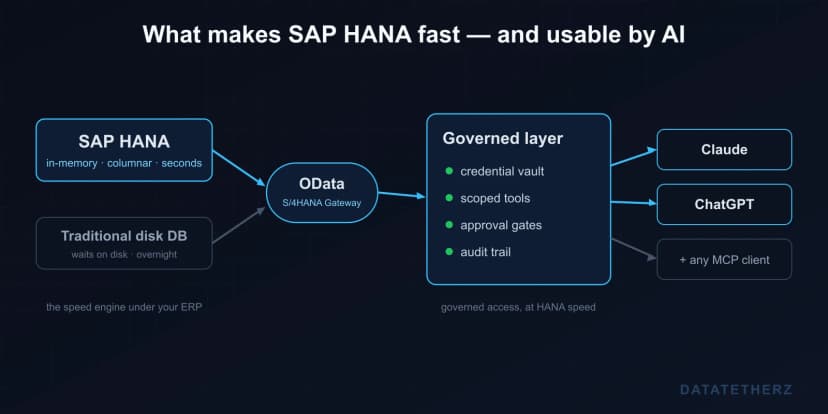
Two standards are quietly deciding how enterprise AI actually gets done. On one side, OData — the API protocol SAP, Microsoft Dynamics, and many enterprise systems use to expose business data with a self-describing schema. On the other, MCP — the Model Context Protocol, the open standard AI clients like Claude and ChatGPT use to discover and call tools.
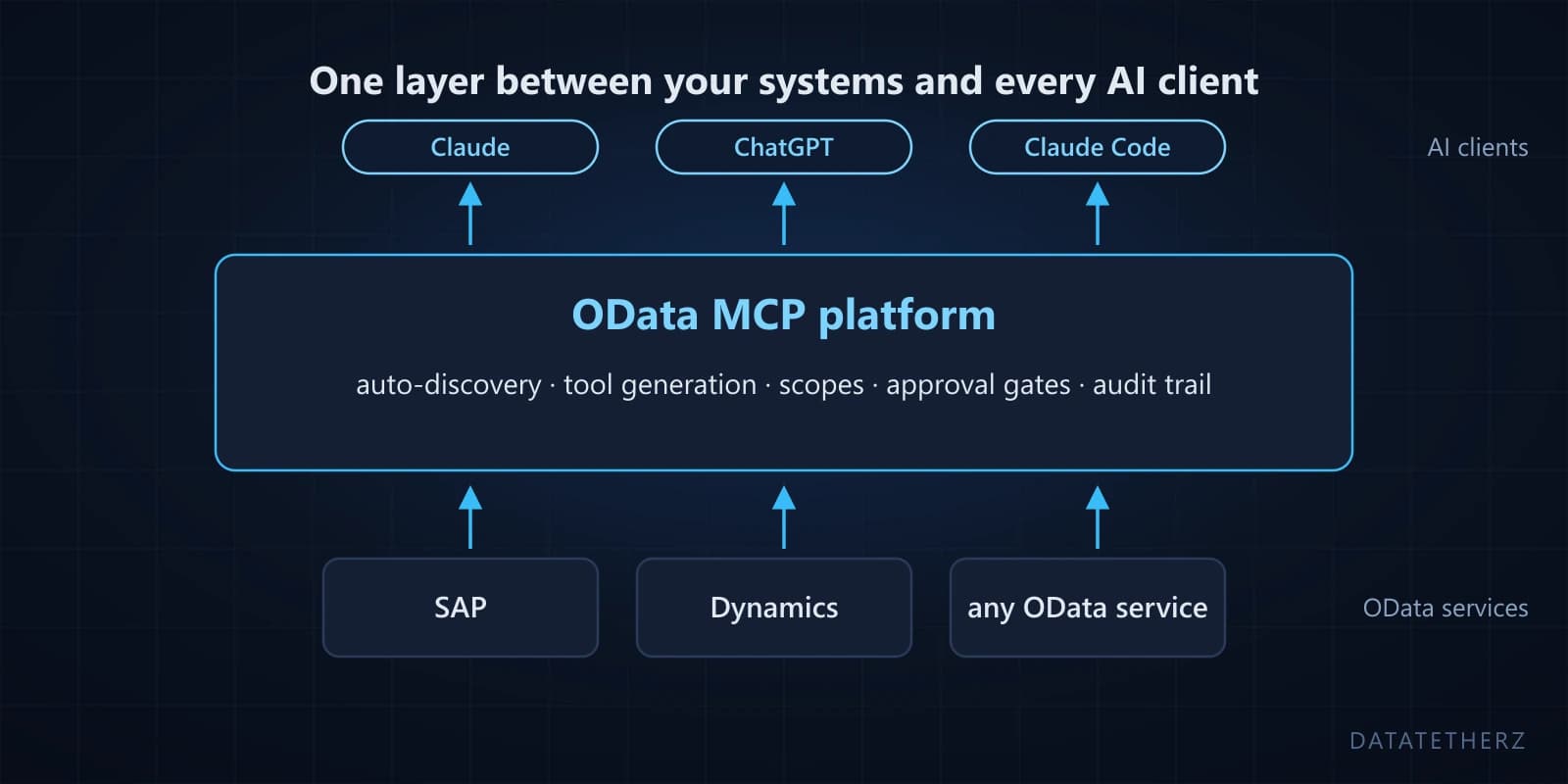
An OData MCP platform is the layer that connects the two: it reads what an OData service publishes about itself and turns it into governed, scoped MCP tools an AI assistant can use. No hand-written integration per service, no custom server per AI client.
Why the layer exists at all
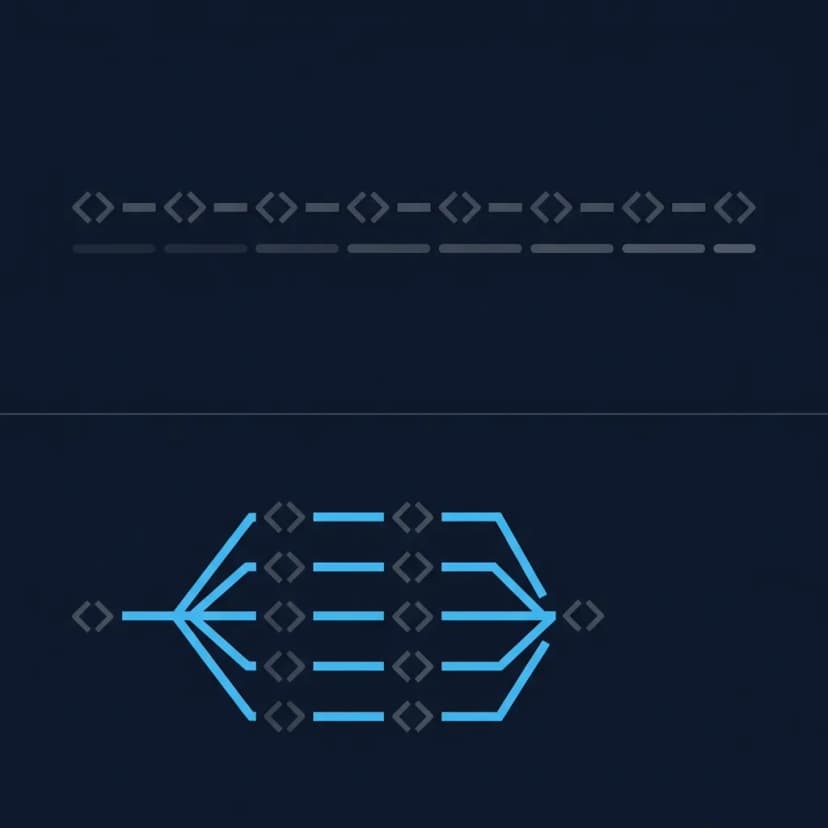
You could connect these two worlds by hand — and teams do. The trouble is what "by hand" means at enterprise scale: one custom MCP server per service, hosting and CI for each, security review for each, a rebuild whenever the young protocol shifts, and all of the governance — scopes, approvals, audit — built from scratch, per integration. The full bill is why so many AI-to-ERP projects stall between demo and production.
The insight behind the platform category is that OData makes the custom work unnecessary. Every OData service ships a $metadata document describing its entities, fields, keys, and functions. That description is rich enough to generate the integration: the tools, their schemas, their documentation — and the governance surface around them.
What an OData MCP platform actually does
Concretely, the layer takes on five jobs:
- Auto-discovery. Point it at a service root; it reads
$metadata and inventories every entity, field, and function — no code, no guessing at schemas.
- Tool generation. Each entity you approve becomes a set of MCP tools (list/filter, get, count, and — if you allow them — create and update), with readable names and descriptions the AI can act on.
- Scoping. You choose which entities, operations, and individual fields are exposed. The AI can't call what you didn't turn on.
- Governance. Reads flow; writes wait at an approval gate for a named human, and every action lands in an audit trail with identity, payload, approver, decision, and outcome.
- Client independence. The result is standard MCP — one endpoint that serves Claude, ChatGPT, Claude Code, and whatever your organization adopts next, with the same scopes and gates for all of them.
If you're newer to the protocol side of this, our docs cover what MCP is and how tools, prompts, and resources fit together.
What to look for in one
If you're evaluating this category — us included — these are the questions that separate a platform from a wrapper:
- Does discovery handle real enterprise metadata? SAP services come with hundreds of entities, cryptic field names, and OData v2 quirks (CSRF tokens, cookie auth). Cleanup, renaming, and noise removal should be built in, not your job.
- Where do credentials live? They should sit in a vault and be resolved per request — never handed to the AI client. This is the core difference from the API-key shortcut.
- Are approval gates default, or bolted on? If writes can execute unreviewed by default, the governance is decorative.
- Is the audit trail complete? Identity, payload, approver, decision, outcome — anything less won't survive an audit.
- What happens when the protocol moves? The platform should absorb MCP spec churn so your configuration doesn't.
- Can it go beyond raw tools? Metadata is enough to generate dashboards, prompt templates, and UI surfaces too — not just function calls.
Where DataTether sits
DataTether is our answer to that checklist: a managed OData MCP platform where one connection generates the tools, the scoping, the approval gates, the audit trail, and optional dashboards — built MCP-native from the start rather than added to an older product. It's the platform layer in the architecture our docs walk through here.
The fastest way to make the category concrete is to watch it work: the Northwind walkthrough goes from a public OData URL to working AI tools in about fifteen minutes, no credentials needed. When you want to see it against a real SAP service, request guided access.

 architecture