If your business runs SAP, there's a good chance it runs on one of the fastest databases ever shipped — and almost nobody outside the IT team ever notices. SAP HANA is the engine underneath S/4HANA, and it's the reason a report that used to run overnight can now answer in seconds. Yet the AI assistant your team pays for — Claude, ChatGPT, Copilot — can't feel any of that speed. It can't see your SAP data at all.
This post fixes both halves of that. First, in plain language, why HANA is fast and what that actually buys you. Then, how you let AI use that speed safely — without handing it the keys to the database.
In memory, not on disk
Traditional databases keep your data on disk and load small pieces into memory when a query needs them. Disk is slow — mechanically slow — so the database spends much of its time waiting for data to arrive. That waiting is why finance close, big inventory reports, and analytics jobs so often became "run it overnight" tasks.
SAP HANA turns that model inside out: it keeps the working data in main memory (RAM) all the time. Reading from RAM is on the order of 10,000× faster than reading from a spinning disk,¹ so the waiting mostly disappears. The report doesn't run overnight because it doesn't need to — the data is already sitting where the processor can reach it instantly.
Columns, not rows — and why that's the trick
In-memory alone isn't the whole story. HANA also changes how the data is laid out.
Picture a stack of paper receipts. A traditional row store keeps each receipt whole — customer, item, quantity, price, date, all together on one line. That's great when you want one full receipt. But when a manager asks "what was total revenue this quarter?", the database has to pick up every receipt just to read the one price field off each.
A column store — HANA's default — files all the prices together, all the dates together, all the quantities together. Now the revenue question only touches the price column and ignores everything else. That single change unlocks a chain of wins:
- Only read what the question needs. Analytical queries scan a couple of columns instead of dragging every field through memory.
- Compression that actually bites. Values within a column are similar (lots of repeated dates, statuses, currencies), and similar data compresses hard — so more of your business fits in memory and there's less to move around.
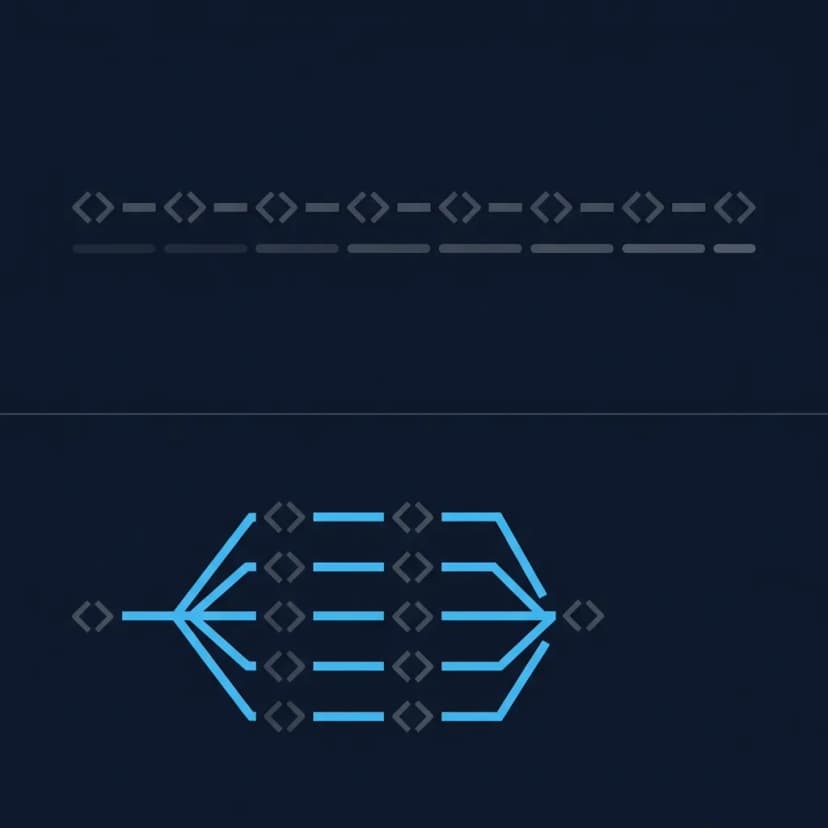
- Built for parallelism. Different processor cores can each work a different column at the same time.
- Fewer indexes to maintain. HANA scans columns so quickly that many of the extra indexes older databases needed just to stay usable simply aren't required.
The short version: HANA reads less data, reads it from the fastest place, and reads it in parallel. That's where the speed comes from.
What that speed actually buys the business
This isn't a story about benchmarks — it's about when you get to know things. Because HANA is fast enough to run analytics directly on the live transactional data, you stop waiting on a separate warehouse and a nightly batch to catch up. Stock positions, open orders, overdue invoices, margin by product — these become questions you can ask against today's numbers, not last night's snapshot.
That's the quiet promise of S/4HANA: decisions on current reality. The problem is that, for most people in the business, "asking a question" still means filing a request and waiting for someone to build a report.
The catch: fast data your AI still can't safely touch
Here's the gap. You have a database that can answer in seconds — and an AI assistant your team already lives in that's brilliant at turning questions into answers. They can't talk to each other. Out of the box, Claude and ChatGPT have no idea your SAP system exists.
The naive fix — hand an AI broad database credentials — is exactly the fix no CIO will sign off on. There's no scoping, no approval step, no audit trail; one confidently-wrong write and you've turned a productivity tool into an incident. Fast data is worth very little if the only ways to reach it are a BI ticket or an ungoverned export.
How DataTether turns HANA speed into governed AI access
DataTether sits in that gap — and it's worth being precise about how, because the honest version is the reassuring one.
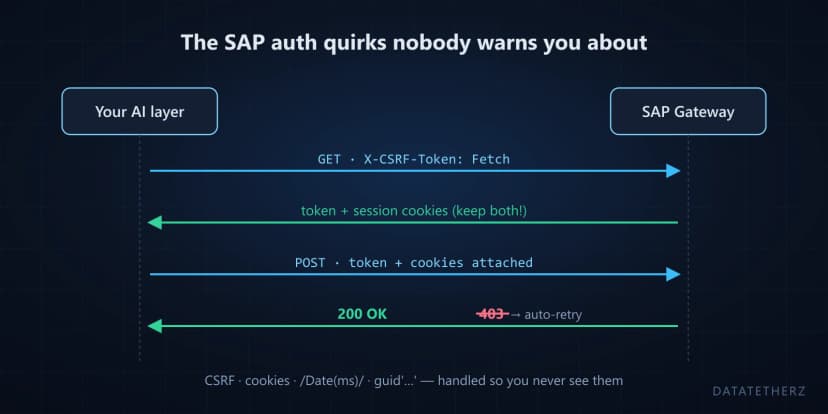
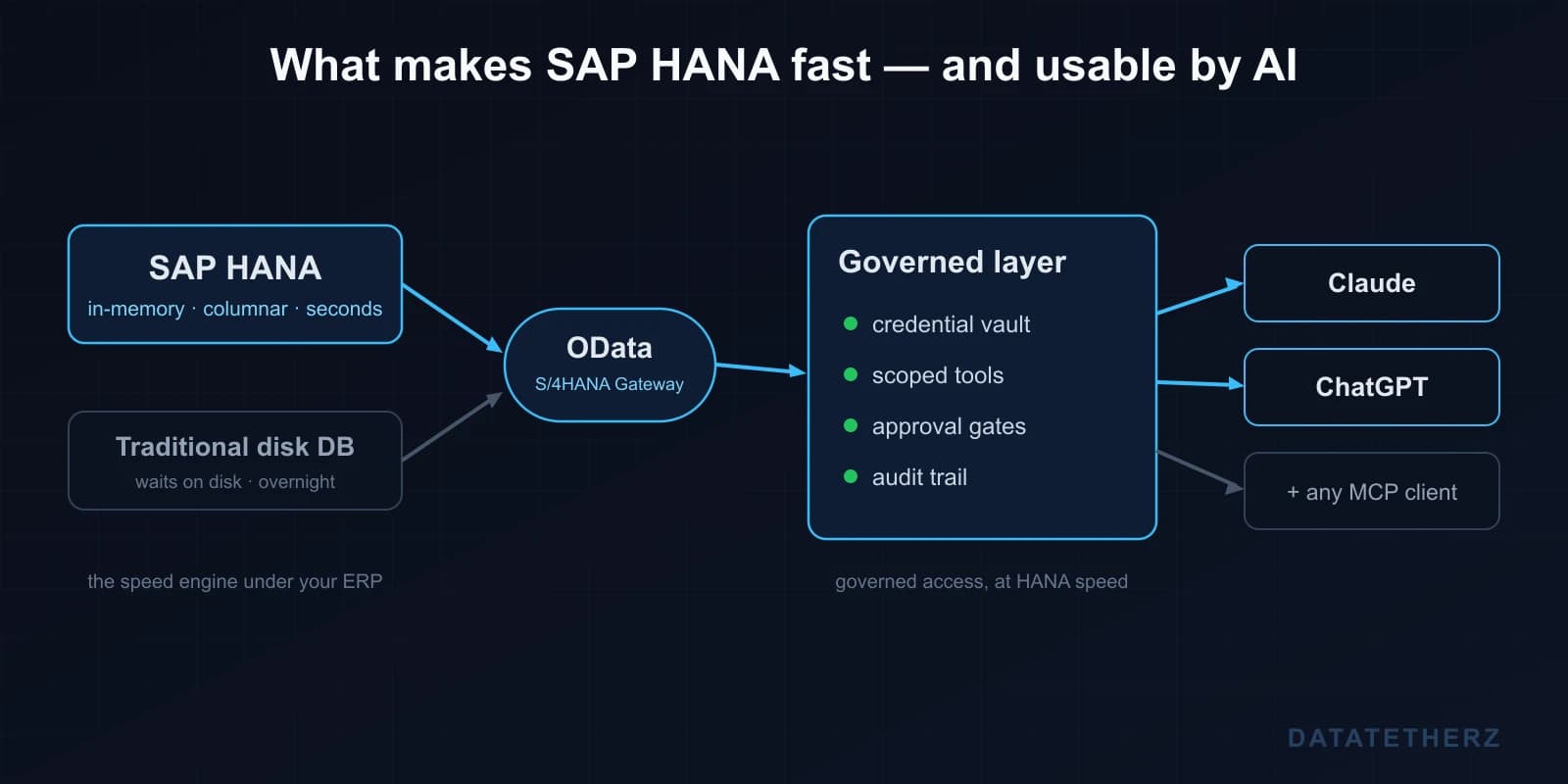
DataTether does not connect to the HANA database directly. It connects to the OData services your SAP already exposes — the same SAP Gateway services your Fiori apps are built on, the machine-readable interface that describes your entities, fields, and keys. From that one connection it reads the metadata and automatically generates:
- Scoped AI tools — Claude and ChatGPT can query only the entities and fields you turned on, nothing more.
- Live dashboards — real tables, charts, and KPI cards rendered inside the chat, backed by live data. (More on those in Claude artifacts vs live reports.)
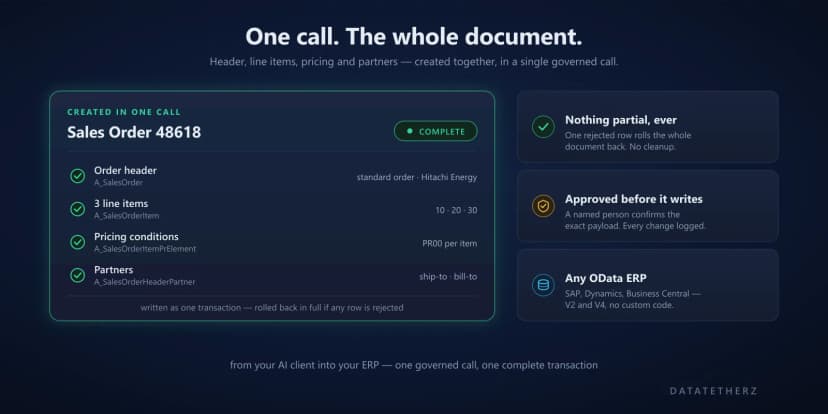
- Human-approval gates — every write is held for a named person to review before it touches SAP.
All of it published as one MCP endpoint that any MCP client can use. And because those OData services run on top of your HANA-backed SAP, the answers come back at HANA speed, live — DataTether never has to touch the database to inherit its performance. If you want the mechanics of that connection, we walk through it in connecting SAP to Claude, ChatGPT and more.
This also matters for the many teams SAP's own Joule doesn't reach — ECC and on-premise S/4HANA shops standardized on Claude or ChatGPT rather than SAP's assistant. We wrote an honest gap analysis if that's your situation.
Fast data, safe hands
The point of putting a governed layer in front of all that speed is that it changes nothing about your security posture. Reads flow freely — ask a question, get a live answer at HANA speed. Writes wait for a human: a named approver sees the exact change the AI wants to make and approves or rejects it before anything reaches SAP. Every action, read or write, is logged with identity, payload, and outcome — the reads flow, writes wait principle in practice.
One detail we're particular about, because speed makes it easy to be confidently wrong: if a question spans multiple currencies, DataTether won't silently add euros to dollars into one impressive, incorrect number. Mixed-currency totals are split or flagged, never blended.
HANA gave your ERP the speed. The missing piece was letting the AI your team already uses tap that speed without anyone losing sleep over what it might touch. When you're ready to see your own SAP data answer questions inside Claude or ChatGPT, request guided access — we'll walk your first connection through with you, from service URL to first live answer.
¹ SAP's in-memory computing materials describe accessing data in main memory as roughly 10,000× faster than reading from standard disk — the core reason HANA moves the working dataset into RAM.

 architecture