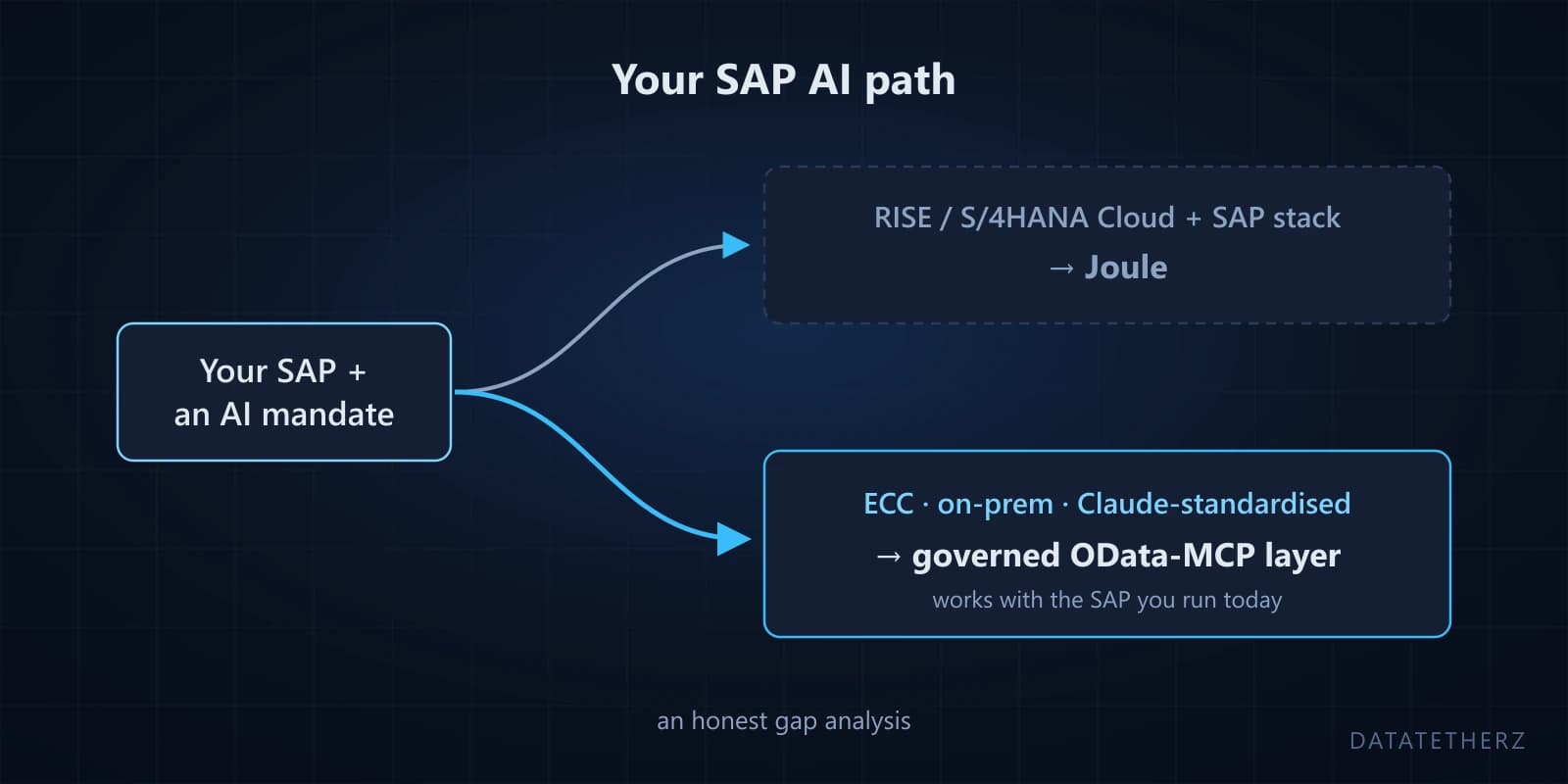
When leadership asks "what's our SAP AI story?", the first name that comes back is usually Joule — SAP's own copilot. And for the customers it was built for, Joule is a serious answer.
The problem is who it was built for. A large share of the SAP installed base still runs ECC or on-premise S/4HANA¹ — and that is precisely the population Joule doesn't reach. If that's you, this post is the gap analysis your steering committee will eventually ask for anyway.
What Joule does well
Credit first. Joule is embedded in SAP's own applications, understands SAP business context natively, and is maintained by the vendor that owns the data model. For organizations fully on S/4HANA Cloud (public or private/RISE), invested in SAP BTP, and content to use SAP's chosen AI stack, Joule offers deep integration nobody outside SAP will match inside those applications.
If that describes your landscape and your AI strategy, evaluate Joule seriously. We'd rather say that plainly than pretend otherwise.
Where the gap is
The gap has two dimensions, and most mid-market SAP shops sit in at least one of them:
The version gap is the hard one: Joule does not run on ECC, and ECC is where a huge portion of real SAP work still happens. But the second dimension matters even for RISE customers — if your organization already rolled out Claude or ChatGPT company-wide, Joule doesn't make your assistant useful against SAP. It adds a second assistant, inside SAP screens, on SAP's terms.
The three options on the table
If you're in the gap, you have three realistic moves:
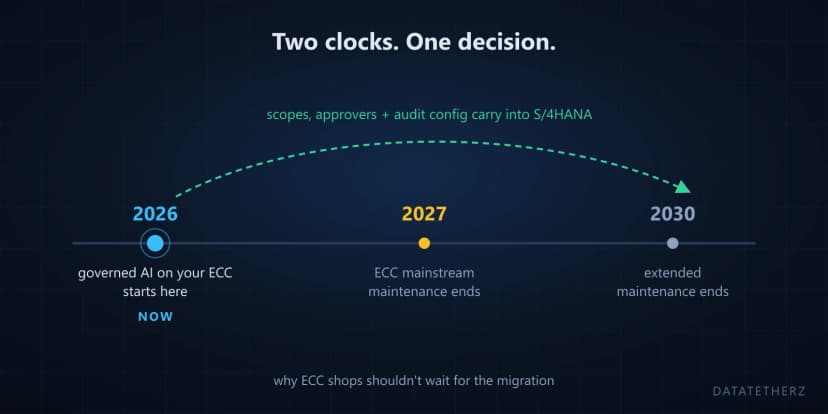
Option 1: Wait for the migration. Defensible on paper, but it typically means years with no AI capability against your system of record — while the board asks every quarter why the AI programme hasn't touched the ERP. We've written about why that waiting position is weaker than it looks.
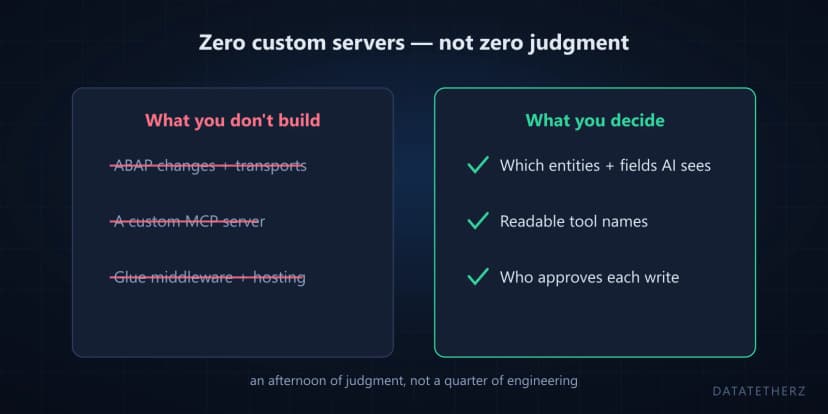
Option 2: Build a custom MCP integration. Your Gateway already exposes OData services, and a capable team can hand-write an MCP server against them. It works — but it's more expensive than the prototype suggests: hosting, testing, protocol churn, and none of the approval-gate and audit machinery that makes AI writes survivable in an audit. Multiply by every service and every AI client your org adopts.
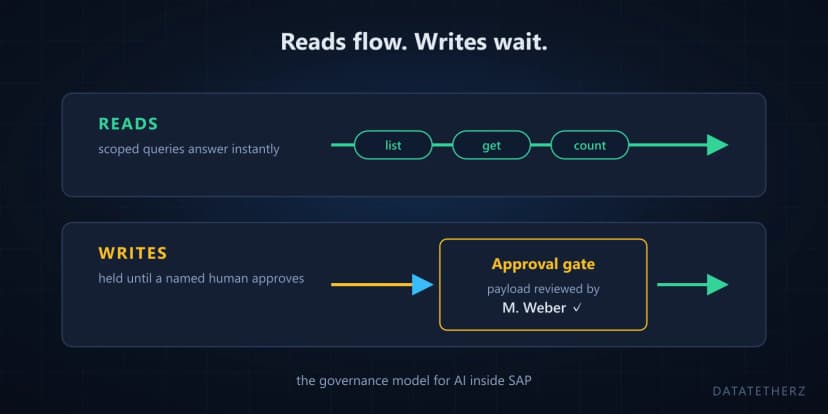
Option 3: A governed OData-to-MCP layer. Use the OData services your SAP already exposes — ECC or S/4HANA, it doesn't matter — and let a managed platform generate the MCP tools, scoping, approval gates, and audit trail from the service metadata. Your existing AI assistant connects to that layer. Nothing changes inside SAP; the migration timeline stays whatever it was.
That third option is what DataTether is. One connection per service, tools generated from metadata, every write held for a named human, and the same setup serving Claude today and whatever assistant your org adopts next.
The question to actually ask
The Joule decision is often framed as "Joule versus something else." For most ECC and on-prem shops it's really: do we wait for AI capability until after a migration, or do we get governed AI against the system we run today? Those aren't competing products — they're different answers to when.
If you want to pressure-test option 3 against your own landscape, request guided access — the first session runs against a live demo service before anything touches your SAP.
¹ SAP has cited around 24,000 ECC customers in recent years, with a substantial share of the installed base yet to complete S/4HANA migrations; estimates vary by source and definition.

 sap
sap