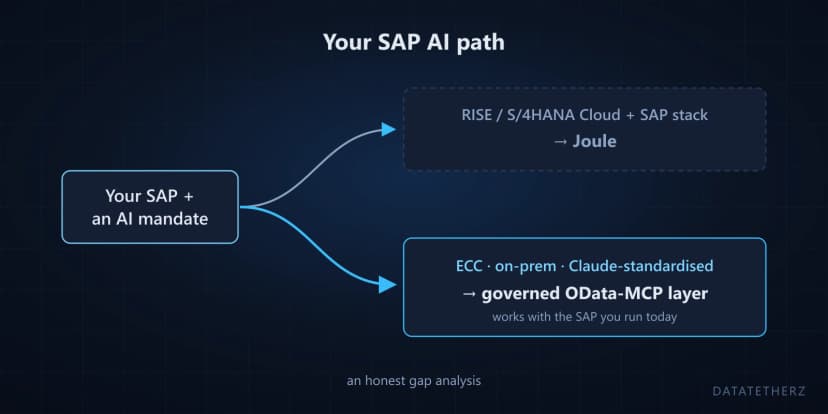
"SAP AI integration, no code" is a search a lot of SAP admins have typed this year — usually right after being told to "get Claude working with SAP" and right before discovering what the custom route involves.
It's worth being precise here, because "no code" is a phrase that usually oversells and underdelivers. Drag-and-drop automation tools wear it proudly and then fall over the moment they meet a real SAP Gateway service — OData v2, CSRF tokens, session cookies, entity sets with sixty cryptic fields. For ERP work, "no code" can't mean "toy." It has to mean something narrower and more valuable: zero custom servers, zero changes to SAP itself — with the enterprise depth still intact.
The three codebases you're actually avoiding
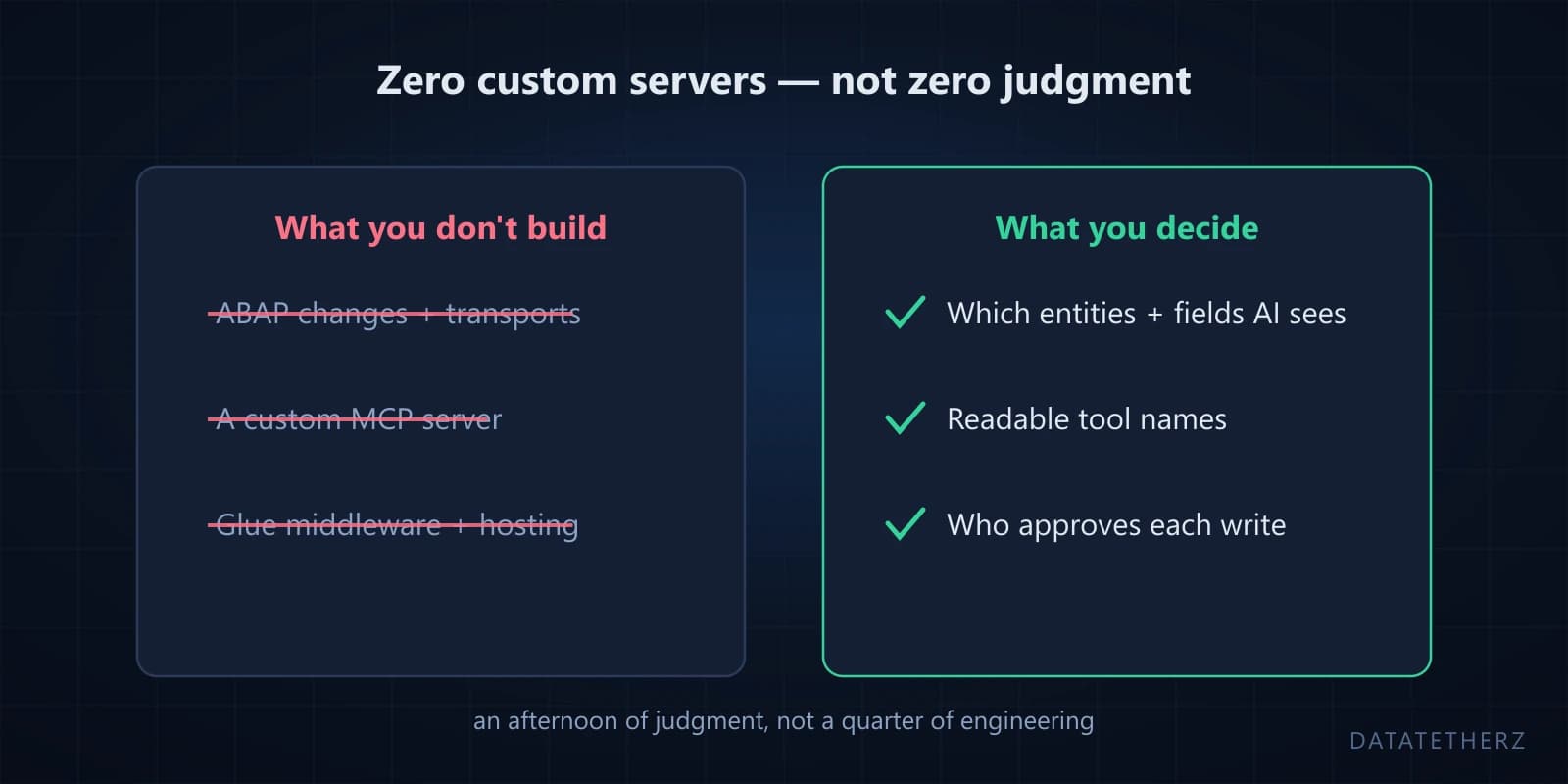
When a team integrates an AI assistant with SAP by hand, they end up owning three pieces of software they didn't have last quarter:
- ABAP changes in SAP. New services, modifications, transport requests through the landscape — the slowest and most politically expensive code there is.
- A custom MCP server. The translation layer between the AI client and OData — a real production system with a real ongoing bill, not a weekend script.
- Glue middleware. Auth handling, credential storage, logging, retry logic — the unglamorous 60% that never appears in the demo.
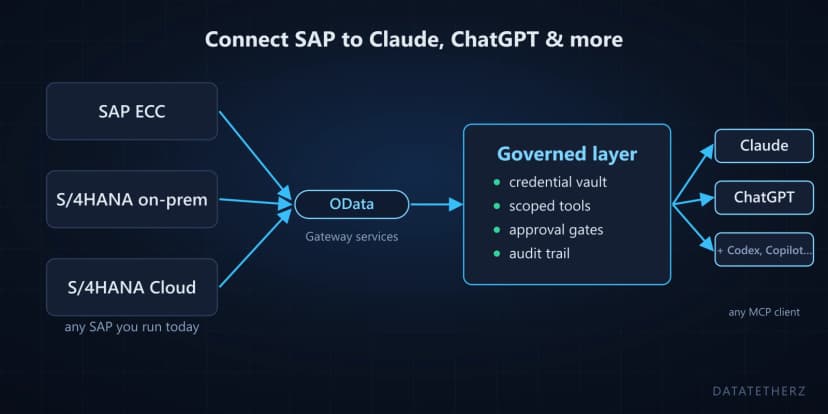
A serious "no code" claim for SAP means all three of those stay unwritten. The integration runs on what SAP already exposes: the OData services behind Gateway, described end-to-end by their own $metadata. DataTether reads that metadata and generates the tools, scoping, dashboards, and governance from it — that's the whole platform category in a sentence. Your SAP system is untouched: no transports, nothing new to deploy inside the landscape, nothing for your team to host outside it.
What still requires a human — and should
Here's the honest half of the claim, because "no code" does not mean "no thinking." Setting this up well involves real decisions, made in a guided flow rather than an IDE:
- Scoping. Which entities does the AI get? Which operations? Which fields? Turning on everything is possible and wrong — start read-only, start narrow.
- Naming and cleanup. SAP's generated names (
A_SalesOrderItemPartner) mean nothing to an AI or a colleague. Renaming tools and trimming metadata noise takes minutes and pays off in every conversation after.
- Approval design. Which writes, if any, do you enable — and who are the named approvers who review each payload before it touches SAP?
That's an afternoon of judgment from someone who knows the system — the SAP admin's judgment, finally applied to AI — instead of a quarter of engineering from someone who has to rebuild what the metadata already says.
The comparison that actually matters
The point of skipping the code was never the code itself — it's that every line you don't write is a line that can't drift, break on the next MCP release, or ship without an audit trail. The governance being built in is what makes the fast path also the defensible one.
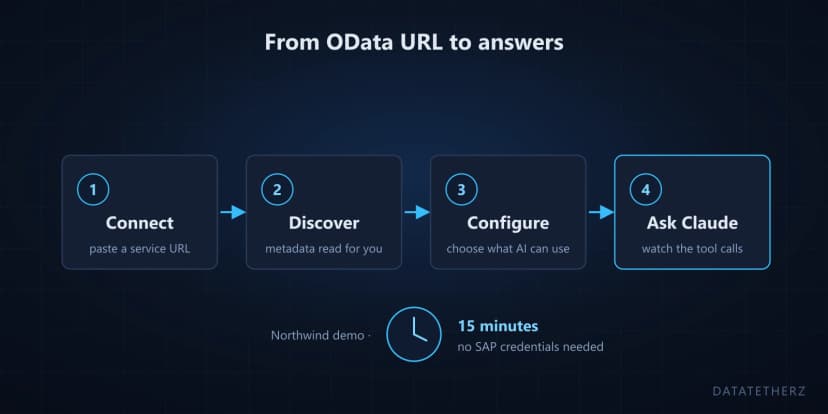
If you want to judge the claim directly, the Northwind walkthrough shows the full flow against a public OData service — no credentials, about fifteen minutes. Then request guided access and we'll run the same flow against your own SAP service, with your scoping decisions, together.

 sap
sap